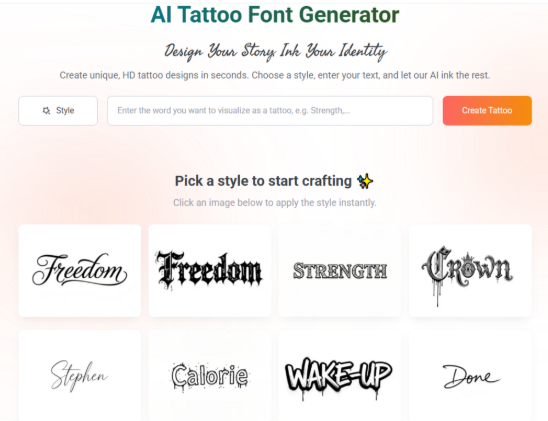
In the realm of body art, precision is everything. While the origins of tattooing are deeply rooted in the tradition of hand-drawn craftsmanship, modern aesthetics are increasingly influenced by the sophistication of digital design. For those looking to leave words on their skin, it’s not just about the text itself; it’s about how the visual construction speaks to the soul. From complex Gothic scripts to minimalist serifs, the choice of typeface defines the tattoo’s tone. This is why digital assistance has become an indispensable part of today’s creative workflow.
Bridging the Gap Between Tradition and Innovation with a Tattoo Font Generator
Tattoo lettering has undergone a massive evolution. In the past, clients had to rely entirely on an artist’s freehand ability, which often came with significant uncertainty. Today, this art form is merging with graphic design logic. As an art enthusiast seeking perfection, utilizing a professional allows you to have a clear grasp of the design’s skeletal structure before you even step foot into a studio.
The rise of digital tools isn’t meant to replace the artist but to empower them. Through online generation tools, you can explore the geometric balance of a typeface. For example, when you input a word, you can observe how the curves of the letters align with the intended body part such as the curvature of the forearm or the lines of the neck under various font weights. This experimental process is a digital extension of calligraphy, keeping the “trial and error” on the screen and leaving the “perfection” for the skin.
Why Professional Designs Require a Reliable Tattoo Font Generator
One of the greatest technical challenges in tattoo design is “skin aging.” Ink naturally undergoes minor diffusion within the dermis over time. If your typeface design is too dense, or if the kerning hasn’t been scientifically calculated, what was once clear text may blur into an illegible mass after a decade.
This is why professionals and seasoned enthusiasts alike rely on it . With such a tool, you can precisely adjust the negative space between letters. A superior generator doesn’t just provide a vast array of styles; it allows for fine-tuning the design to ensure legibility remains intact even after minor ink migration. This mastery of detail is what separates a mediocre tattoo from a masterpiece. Furthermore, starting with a digital template provides the artist with an exact reference, reducing communication errors and ensuring the authoritativeness and lasting beauty of the final artwork.
The Skin as a Dynamic Canvas: Practical Insights for Digital Tools
We must realize that the skin is not a flat sheet of paper, but a dynamic, multi-layered biological tissue. The advantage of a digital font generator is that it provides a standardized visual benchmark. When you export a high-definition design from a generator, you are essentially creating a “blueprint.”
This blueprint includes not just the shape of the font, but the underlying logic of proportion. For the modern crowd pursuing fine-line tattoos, this logic is vital. Fine lines can easily fail due to minor variations in depth. Through digital pre-planning, you can evaluate whether every sharp corner and curve of the font is within the executable range. This rigorous approach, based on both experience and specialized tools, is something everyone looking to make a permanent mark on their skin should possess.
Conclusion: Toward a New Era of Precise Aesthetics
Tattooing is a timeless art, but the methods to achieve it are evolving with the times. Whether to express faith or commemorate the past, the form of the font is just as important as its content. Don’t let your inspiration be limited by crude sketches. Embrace the precision brought by digital tools—explore, design, and generate. When you use advanced algorithms and aesthetic libraries to find that perfect balance, your tattoo is no longer just ink; it becomes a visual masterpiece that transcends time.